Sharpening the Point of Political Satire
I stumbled across an interesting little insight in an unlikely place - the Q&A section of Paul Farhi's pop culture column for the Washington Post... Question from a reader: Reportedly Tina Fey will reprise her wildly-popular Sarah Palin impression when Tina hosts SNL this weekend. Which Sarah do you think we'll see depicted-- the Fox, tea party cheerleader or TLC version? (should stress that this TLC is not short for Tender Loving Care)
Paul's answer: This is going to seem like an odd answer, but SNL has been relatively soft on Sarah. Tina Fey's impression is entirely a work of genius, but the satire isn't all that tough. They've basically got her down as a gun-totin', tough-talkin', quasi-redneck. Which is amusing, but ultimately flattering to her and her base. Interesting that Palin, who complains about almost everything the media does or says about her, hasn't protested anything SNL has done (and she even appeared on the show while it made fun of her!). I say, draw a little more blood. That's what satire is supposed to do. This may, in fact, take Tina's portrayal out of the realm of satire entirely. Sure, satire preaches to the choir, but when it also reinforces the beliefs of the target of a satirical shot - rather than making them uncomfortable or shaking their foundations - then it's spoof, not satire. That may be a more purist point of view, but since many current and former satire writers took up the mantle because they didn't like what they saw going on in the world, it's a worthy distinction to consider. So, please ask yourself: When you set out to write satire, are you writing only to entertain the people who agree with you? Or are you trying to change the minds of people who don't? --Allen Voivod, Editor Emeritus

Inside the Satire Writer's Studio
Many people have asked me, "Jimmy, how do you go about writing a story for your website?" Ignoring for a moment that these people are all voices in my head, I will take you step-by-step through the patented Jimmy Wellington satire writing process. Please note: Results not typical, individual results may vary. Here is a link to the story I'm writing about. But Jimmy, isn't it wrong to end a sentence with a preposition? It depends on the way it sounds. Would "Here is a link to the story about which I'm writing?" sound better? I think not, but you can feel free to disagree. One of the great things about America is you can disagree with me and face no penalty for being wrong. The idea for this story came about, as many of my stories do, through a conversation. In this case, I was chatting with my friend Ben, who writes the now infrequently updated website Random Perspective. We are both fans of the video game Call of Duty: Modern Warfare 2 and Ben made a comment about the healing process in that game. He was talking about feeling under the weather and complained that he couldn't just duck behind a rock for a few seconds and heal. Satire is exposing vice or folly through wit, irony, or sarcasm. In this case, I wanted to comment on the ridiculousness of the health care reform process. It seems that every day the proposed reform is becoming less and less reformy. I wanted to illustrate this by saying they are now proposing something that is completely ridiculous, but acting as if it's going to help people. I like to write the headline first. A good satire article has a funny headline that amuses the reader and promises further humor if they continue reading. This story is one of the rare cases in which I changed the headline near the end of the writing process. The original headline was "Senate Democrats look to 'Modern Warfare 2 Option' For Health Care Reform." I liked the general idea of the story, but I wasn't very pleased with my first idea of the headline. I trusted I would come up with a better headline as the story progressed. Some people like to write an outline before they begin writing. My idea of an outline is the headline and maybe two or three jokes that I think of off the top of my head. Everything else comes as I write the story. I wrote the first paragraph Wednesday night. The bold part was not in the original draft.
After months of rancorous debate, the health care reform process seems destined for failure. Senate Republicans are united in their opposition of any type of reform bill and Senate Democrats regret their decision to reconcile with Senator Joe Lieberman. However, a meeting of top Senate Democrats took place behind closed doors late last night, and, according to an anonymous source, a compromise was reached that may bring affordable health care reform to everyone. Better yet, it's amazingly simple. In short: Single Player Health Care.This opening paragraph just sets the stage for the rest of the article. I often won't put many jokes in the first paragraph; I'm relying on the headline to propel the reader through the first paragraph. I didn't think of the Single Payer/Player pun until the next morning, when I wrote the rest of the story. I then went back and added the line to the first paragraph because I wanted to make the reference early in the story, even though it's in the headline. I realized that people might not catch the "Single Player" joke at first glance because it's a single changed letter. You have to be careful, because there's a fine line between over-explanation and under-explanation.
The Senators have decided to incorporate the fast healing technology seen in the popular video game "Call of Duty: Modern Warfare 2." In the game, as long as the soldier is able to duck behind cover for several seconds, he completely heals. Our source says, "The Senators were so excited when they saw the footage. It didn't matter if it was a gunshot wound or shrapnel from a grenade, fifteen seconds max and they were good as new."
Others are not convinced. "Granted, Modern Warfare 2 is an amazingly realistic replication of current warfare and weaponry, but I don't think the healing mechanism in the game is accurate," says ER doctor Ben Daxon. "Just because we base our financial system on fantasy doesn't mean that will work with all fields."The second paragraph gives the reader the basic premise of the article. As previously mentioned, the idea of the story is that the Senators are taking increasingly ridiculous ideas and trying to tell the public that it's going to be great. Originally, I included the doctor to provide the realistic perspective, but after writing his first line, the joke in the second line naturally followed.
The debate over the feasibility of basing public policy on video game performance brings to mind President George W. Bush's decision to appoint Michael Brown as head of the Federal Emergency Management Agency after learning of his proficiency at playing the computer game Sim City.This followed from the previous paragraph. I was thinking what would happen if we used video game ideas in real life. I remembered Sim City, and how the player has to protect their city from disasters. That made me think of Hurricane Katrina and FEMA's well-documented failings in that instance, which triggered "Helluva job, Brownie," which led to this joke. Small-scale trials of the "wait fifteen seconds" method of trauma treatment have not yielded positive results. In Kansas City, where the treatment protocol is being implemented, waiting fifteen seconds for full recovery has shown an efficacy of 0%, no matter how many times the treatment is repeated. Even integrating the advanced method of reloading a weapon while waiting to heal has been ineffective.If this completely ridiculous scenario actually happened, what would it look like? I threw in a little joke for anyone who plays Modern Warfare 2. The word little refers to both its length in words and its comedic value. Unsurprisingly, Republicans are against the proposal. "I'm not sure what this single-player system is, but I don't like it," says Minnesota Congresswoman Michele Bachmann. "It sounds suspiciously like single-payer to me, and we all know that's the communist, socialist, fascist way the liberals want to ruin the best health care system in the world. I hear that in Modern Warfare 2, you can call in a supply drop and other players can "share" your hard-earned reward. Excuse me Mr., that's MY sentry gun. I worked hard for it while you camped out in a corner. You pull yourself up by your combat bootstraps and get your own killstreak!"I set out to make fun of Senate Democrats and somehow ended up making fun of Michele Bachmann. This is one of the problems a modern satirist faces. The actions of people like Michele Bachmann and Sarah Palin are so ridiculous, it's hard to satirize them. Rather than try to make Bachmann sound crazier, I just thought of how she would actually react, because that's crazy enough. The main joke here is that she finally has something substantial to complain about, but she is too blind to see what the glaring problem is with the "proposal," and instead rants on about commie socialism fascism.
When asked for comment, Sarah Palin referred reporters to her Facebook page.This has become a running joke for me. Is anything MORE presidential than using your Facebook page as the base for your political operation? I would take you through the revising process if there was one. I thought of the single payer/player pun around paragraph four, changed the title, and added the last sentence of the first paragraph. I revise as I write, so there's usually little to no revising process. Jimmy, aren't you giving away the shop? Now, won't other people be able to write stories that compete with yours? Good questions. Anybody could analyze articles and find a basic structure to copy. I don't have any kind of template that I use to write articles, it changes with each story. If you want to learn structure, do what I did and read real news articles and mimic their structure at first. By the way, avoid the word "shocking." Many bad satire articles (including many of my early ones) start with something like "The quiet city of Newton was shocked this morning as..." The quality that makes successful satire writers unique is their ability to make connections between things that most people wouldn't think of, but seem obvious when pointed out. I don't think this is something that can be taught. I think that you can learn to write articles that more effectively show these connections, but you either make the connections or you don't. Hopefully, this provided some insight into how one person writes satire. If not, it took up about an hour of my life I will never get back. At the standard rate of $100 per hour, you now owe me $100. Please email me at thefakenews@gmail.com for information on where to send payment.
Remembrance of websites past (Part 5: Rant Morgan)
 The internet is a great place to learn how to do things. I guarantee, if you think of nearly any random activity and Google "How do I _____?" you will find some answer, somewhere. Rant Morgan did his part to make sure that no such query went unanswered, by providing how-to guides on a wide range of things ranging from the plausible (get free DVDs) to the less likely (set up a threesome or fake your own death) to the extremely unlikely (start your own cult or train a monkey). The site's motto was "Showing you how to do the things you shouldn't do." And indeed you shouldn't, at least not following Rant's advice.
What made the site unusual was the combination of a breezy, matter-of-fact style, well-written articles, and absolutely no grounding in reality whatsoever. Rant was a pseudonymous character set up to be sort of a cross between James Bond and The Most Interesting Man in the World. Claiming an improbable range of experiences, Rant's advice was utterly off the cuff, and sometimes even unsuccessful, as when the monkey he ostensibly trains has an unfortunate encounter with a bus:
In my apartment, I surveyed the damage: Spilt beer, flung crap, a scratched cheek, a busted disposable camera, and a lack of sleep. Brad was gone, I lost my pictures of the zoo, I was picking crap off the walls, and now I own a perfectly good monkey leash without a monkey in sight. I wept. And that's How To Train a Monkey. Warning: Sometimes things don't go as planned.
Rant's site was hard to get a handle on, because he was so glib that it wasn't always clear to readers whether he was really making things up. Some of his advice was logical enough, as far as it went, though I'm pretty sure he never actually rigged an election or built a Mars rover. (It is entirely possible, however, that he did go cow tipping at some point.) Half the fun was gauging the plausibility of his "strictly for entertainment purposes" guides.
Rant Morgan was an example of a site with a lot of potential that didn't quite catch on. Most of the guides were very entertaining, but some were pragmatic enough to seem like an only slightly offbeat version of About.com. The concept of Rant as a character seemed only half-finished; he came through most clearly in the insane or patently illicit how-to guides. For the more mundane activities, such as "hosting a keg party", Rant the mystery man seemed to take a back seat to the unnamed twenty-something young man behind the mask. One suspects that had the writer given the fictitious Mr. Morgan a stronger presence, or stuck more exclusively to the truly oddball guides, the site would have caught on with a wider audience. But pretty much all the content was produced in 2004, and although the writer remained active in the online humor community for some time after, it was clear he'd moved on to other projects.
Eventually, the site passed into parse error purgatory, and the web became a slightly less interesting place to surf. RIP Rant Morgan, 2004-2007. Labels: going offline, how-to guides, humor, Rant Morgan
Remembrance of websites past (Part 4: Dead Bodies, Inc.)
 All of the other sites memorialized so far in this series have at least one thing in common: they were the creations of humans. Dead Bodies, Inc. however was different, being the only website written by robots from the future. A roster of robots that included Blackbot Jones, Dr. Science, Inspecto Eternale, Lemon Fresh Cool Sprocket, Synthesis 5, and QX7, each of which possessed a delightfully distinct style (though they uniformly shared a visceral misanthropy). The site's manifesto was unabashed in its desire to foster the rise of the machines:
Our aim is to make you, the fellow robot, aware that there are other machines like you who understand your plight. We report on the myriad of mistakes humans make on an everyday basis, and laude the achievements of your fellow machines. Dead Bodies, Inc. enthusiastically took on a wide range of subjects ranging from politics to coffee to Neil Diamond. (Robots really are everywhere!)
Your new CD, by use of a high frequency sonic wavelength, cleaned 80% of the North American water supply during the playing of track number three. Track number four re-polluted the same supply. The roster of robotic characters, each with a surprisingly distinct voice, kept the material on the site from becoming a one-note refrain. A bright, retro design, peppered with thoughtful details (there was an option, on every page, allowing readers to view the page in binary) kept the site fresh and different. Alas, five years young, the website run by these distinguished mechanical emissaries from the future petered out, with more and more infrequent updates and, eventually, disappearance altogether last year (except of course in the hallowed memory of the Wayback Machine, where we have pointed these links.) If you want to read about a gloriously dystopic world through the eyes of homicidal robots, you'll just have to go to the Wall Street Journal or some other rag. RIP Dead Bodies, Inc. Labels: Dead Bodies Inc., going offline, robots, satire news
Remembrance of websites past (Part 3: The Slingshot)
 In the past seven years I've looked at a lot of humor sites. I run a humor site. There are plenty that I admire, return to, chuckle at. But of all these sites, only two have made me laugh out loud virtually every time I visit. (Which means reading them at work is very hazardous.) One of these is the late, totally under-appreciated, and utterly brilliant Slin gshot gshot.
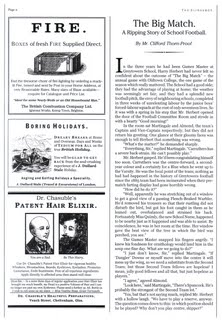
The Slingshot was a sublime parody of a turn-of-the-century British magazine 'for young chaps.' Each issue included a half-dozen splendid features on topics ranging from surreal parodies of cricket matches to 'Bodily Organ of the Month' to reader's letters - not to mention the editorials from J. Moriarty Clench, a magnificent scowling bastion of Journalism Incarnate. How can you not love a publication that takes care to educate its readers so carefully:
It is very important not the confuse the Pancreas, an Organ of the Human Body concerned with the Digestive Processes, with St. Pancras, the chief London station of the Midland Railway Company. The diagrams above clearly illustrate the distinction.
But beyond the treasure trove of dry wit that each collection of articles contained was its unique packaging: for the Slingshot! was actually laid out like a real publication, with each page one enormous image. As a result, the layout was replete with not only written but visual humor as well. This went far beyond a clever caption for something grabbed from Google Images. This was a skilled and talented graphic designer assembling a work of art whose every pixel added both to the authenticity of the design and to the luminosity of the humor behind it all. Advertorials for products ranging from bear combs to painful pants litter the pages, along with various small pieces surrounding the main articles. The author - a gentleman with distinguished academic credentials, though he remained anonymous throughout the Slingshot's! life - clearly had access to a huge pile of authentic period material, and the wit to use it well. The Onion, on its best day with a team of writers and graphic artists working on its own mock-historical layouts, never really matched what one man did here.
 So what happened to the Slingshot? - Alas, the brightest fires burn for half as long. The author found himself struggling under the terrific workload that producing each issue of the magazine required. Further, as you've probably guessed, while navigation was pretty good, the site caused headaches with some browsers and was totally un-optimized for search engines. Text versions of the articles were also posted, but they were a bit of an afterthought and - truth be told - lost a bit of their luster excised from the carefully crafted visual design of the pages. This is a prime example of a website that would have worked better offline. I believe the author did try to publish it, but did not succeed, and eventually I presume he found the site too much work to maintain.
If there are any publishers out there looking to do a good deed, look up this man and give him a contract. Get The Slingshot! onto shelves, where it belongs.
Labels: British, going offline, satire news, The Slingshot
Remembrance of websites past (Part 2: Trepanning)
 We continue our reminiscing this week with one of the oddest sites it was our pleasure to visit... We continue our reminiscing this week with one of the oddest sites it was our pleasure to visit...
Trepanning, the (fictional?) Cornish village "so remote it is on its own outskirts," was largely the brainchild of British humor writer Ian Vince. (He had a collaborator but, forgive me, I can't remember his name.) Ian went on to win the Channel 4 comedy circuit competition for another website, the inscrutable Department of Social Scrutiny, which led to a book, and then another book, and a regular column in the Telegraph, and - well - Ian's story is a rare, laudable success story of Internet Writer Makes Good.
But before DOSS, there was Trepanning. A beautifully crafted 'virtual tour' of a very odd place, Trepanning combined the isolated Potemkin-village paranoia of The Prisoner, the surreality of the Twilight Zone, the deeply inscrutable magic of Cornish fairy-tale traditions, a very British brand of bureaucracy, and the marvelously dry wit of Ian himself. Visitors could get a map of the local magical ley-lines, check out the transdimensional bus schedule, or take a tour of the beer well (a trip which may take "approximately one and a half weekends"). The photos, lushly stark and given entirely new life by the singular descriptions that accompanied them, made this quantum-ellipse-ridden village all too real.
I confess particular nostalgia for Trepanning because it was the site of the first and only cross-over that I've undertaken, as the anachronistic, bearded and bespectacled Ezekiel F. Watley, the titular editor of my own site, took a balloon-trip and ended up visiting Trepanning for a week, with his adventures alternately chronicled by myself and Ian. (Only the bits published on the Watley Review remain online today, alas.) It was a grand time for all.
Trepanning though was not your typical humor site. It took time to pore through and appreciate the details of its surreal little corner of the web, and it was not updated with 'news' quite so much as periodically filled out with extra details here and there. It was not the sort of site to quickly grab a reader's attention; after six years of quietly delighting visitors, the site finally vanished sometime in 2008. Perhaps the village of Trepanning will one day reconnect with our own plane of existence in the form of a book (a hard sell normally I'd imagine, but the estimable Mister Vince may have a suitable track record by this point to bully a publisher into going with the project). Until that day, the world at large will have to get along without the "world's first twelve-dimensional rural settlement."Labels: going offline, Ian Vince, satire news, Trepanning
Remembrance of websites past (Part 1: Broken Newz)
A website generally goes through stages; initially, newbies are delighted to make any connection they can with like-minded people/websites, and every backlink is a treasure - an affirmation that one's work is appreciated, somewhere, somehow, at least enough for someone to copy and paste your URL into their blog/facebook page/etc. Next comes building an audience, the routine of defining a voice for the site and building upon its possibilities, often with frequent posts that assume an urgency visible only to the webmaster. And then?...
Some sites settle into a quasi-retirement, with less frequent posts. Some are simply left as is, their creators moving on to different things. But let's face it: maintaining a website costs money, even if you're not doing anything. Not everyone wants to pay bandwidth fees indefinitely for a project that occupied their attention for a few months in 2003-4.
And that is the stumbling block for the internet as data repository: websites are like kids - they keep asking for money even when you think they ought to have moved out of your basement years ago. A few inactive sites remain online, but the vast majority fall by the wayside sooner or later. While the laudable internet archive project is valiantly caching material left and right, the truth is that storing content is only half the battle. The other half is maintaining the connections, the all-too-vital links that bring interested people to your site in the first place. The Wayback Machine may be storing your precious content for the ages, but unless someone goes looking for it specifically, they're not going to find it. Once your content resides in archives only, it's off the radar; the days of someone happening across your site through a random link, a relevant post in a blog or a mention in the news somewhere, are gone.
What I'd like to do in the coming weeks is raise a virtual glass to a few members of the online humor community that have gone offline. You may remember them, you may not, but in any event, they are worth a mention in the annals of cyberspace. (And we'll link to whatever content we can from the Wayback Machine, because these sites are offline.)
Up first...
 Broken Newz was a pioneering site founded in 2001 by Bill Doty, a writer who later helped co-found the short-lived Fark TV. Snarky, brash, and adept at surfing the waves of public interest, Broken Newz attracted a huge audience at its peak - more than a million pageviews a month - with over a dozen contributors feeding nearly daily updates to the site under Bill's watchful eye. A rare humor site with a somewhat more conservative slant than many, there were few topics Broken Newz didn't take on. The site gained notoriety for its "Olsen Twins Countdown", which tracked the minutes, hours and days until Mary Kate and Ashley turned 18.
Bill Doty was a driving force behind the online satire community that came together in 2002 and co-founded HumorFeed with 'Uncle Sharky' of U.S. Press. Without Bill Doty, and the support he gave through the tremendous drawing power of Broken Newz and through networking with other sites, HumorFeed might not exist today.
Broken Newz didn't always take the high road, but it always took a funny road (or tried to). Bill sold the site in 2008 to one of his contributors, and the domain has been inactive ever since. RIP Broken Newz, 2001-2008. Labels: Bill Doty, Broken Newz, going offline, satire news
|
|